i.Blue — the ocean's memory
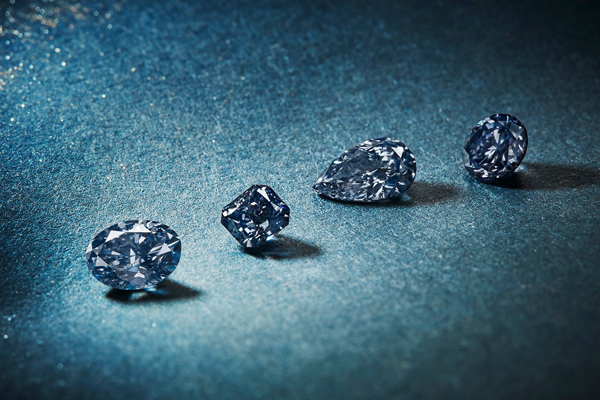
Natural blue diamonds — classified as Type IIb — carry a few atoms of boron among billions of carbon. Research published in the journal Nature (2018) traced that boron to ancient oceanic crust: seawater minerals dragged deep into the mantle by tectonic plates, over hundreds of millions of years, before the diamond grew around them. A blue diamond is, quite literally, a fragment of a vanished ocean.
They form deeper than most diamonds — some at depths beyond 600 kilometres — and reach the surface in rare volcanic eruptions. Historically they came from India's Golconda region; today the Cullinan mine in South Africa yields most fine blues. Roughly 0.02% of all diamonds mined are naturally blue, and the boron that colours them also makes them semiconductors — they conduct electricity, a trait no other gemstone shares.
ii.Yellow — nitrogen's warmth
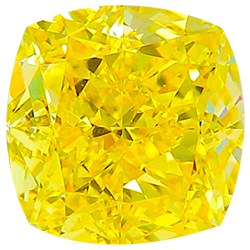
Yellow diamonds owe their colour to nitrogen — the most common impurity in diamond. When single, isolated nitrogen atoms substitute for carbon in the lattice (Type Ib), they absorb blue light and the stone returns a vivid yellow: the celebrated "canary" hue. When nitrogen clusters in groups, the effect is weaker — which is why faint yellow tints sit at the bottom of the white scale, while a saturated Fancy Vivid yellow is a collector's stone. Cut concentrates the effect: radiants and cushions trap light so the colour deepens at the stone's heart.
iii.Pink & red — colour from catastrophe
Pink diamonds contain no meaningful impurity at all. Their colour comes from plastic deformation: after the crystal formed, tectonic forces squeezed and warped its lattice, creating "graining" planes that absorb green light and leave pink. Press the structure a degree further and the diamond turns red — the rarest colour of all. This is why pink is so capricious: the same pressure that creates colour, applied unevenly, leaves the hue patchy and zoned, and a stone of even, saturated pink is the fortunate exception.
The world's great source of pinks, the Argyle mine, owed its stones to a billion-year-old continental collision. Its story — and its closure — is told in Chapter III.
iv.Green, and the rest of the spectrum
Green diamonds were coloured after they formed: resting for millions of years beside naturally radioactive rock, their surfaces were gently irradiated until the lattice absorbed red light. Because the colour often sits in the skin of the stone, a cutter may polish it away entirely — fine greens are decided at the wheel, not in the mine. Oranges and violets arise from rarer still combinations of nitrogen configurations and deformation; browns and champagnes, the most democratic of the fancy colours, share pink's deformed lattice in softer measure.
| Hue | Cause | Signature sources |
|---|---|---|
| Blue | Trace boron from subducted ocean crust (Type IIb) | Cullinan, South Africa · historic Golconda |
| Yellow | Isolated nitrogen atoms absorbing blue light (Type Ib) | South Africa · Russia · Australia |
| Pink / Red | Plastic deformation of the lattice under tectonic pressure | Argyle, Western Australia (closed 2020) |
| Green | Natural irradiation over millions of years | Brazil · Central & Southern Africa |
| Orange / Violet | Rare nitrogen configurations with deformation | Scattered, single-stone discoveries |
v.Why the science matters at the bench
Understanding origin is not academic. A cutter planning a pink must read its graining to keep colour even; a setter choosing metal knows rose gold deepens pink while platinum cools a blue; a buyer reading a GIA report looks first for the words "natural colour" — the distinction that separates a geological miracle from a treated or laboratory-grown imitation. It is also the science behind our group's patented process: matching stones by colour and clarity so precisely that assembled diamonds read as one. Continue to Chapter III — A History of Pink ↗.