i.Golconda — the first pinks
For most of recorded history, all diamonds came from the river gravels of India, and the fabled mines of Golconda supplied the courts of Persia and Europe. Among them appeared occasional pinks — stones like the 60-carat Noor-ul-Ain, centrepiece of the Iranian crown jewels, and the Daria-i-Noor, a pale pink table-cut of some 182 carats. These were not commodities but regalia: pink was the colour of kings precisely because almost no one else could ever hold it.
ii.1979 — smoke on the horizon
In October 1979, geologists exploring the Kimberley region of Western Australia found diamonds in the dried bed of Smoke Creek. The deposit — a lamproite pipe rather than the usual kimberlite — became the Argyle mine, opened in 1983 and, within a decade, the largest diamond producer on earth by volume. Most of its output was industrial and brown. But hidden in the stream of production, at a rate of roughly one pink for every million carats of ore, came the stones that would define an era.
Argyle pinks were different: smaller than Golconda's, often included, but with a saturation no other source has matched — the intense, almost raspberry pinks that became the mine's signature. Over 37 years, Argyle supplied more than 90% of all the pink diamonds the world has ever traded.
iii.The tender — selling scarcity
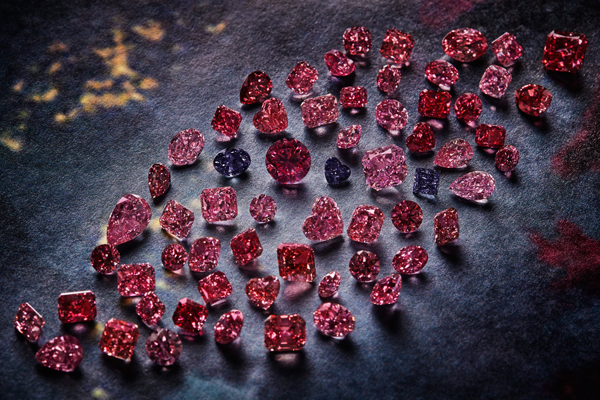
Rio Tinto, the mine's owner, invented a ritual that made pinks a market: the annual Argyle Pink Diamonds Tender. Once a year, fifty to sixty of the year's finest stones were offered by sealed bid to a few dozen invited dealers. Prices were never published; bidders competed blind. Through the 2000s and 2010s the tender stones grew smaller and the prices steeper — the market slowly understanding that the mine was finite.
iv.November 2020 — the mine closes
On 3 November 2020, after thirty-seven years, Argyle ceased production. The last tender, in 2021, offered the final stones — among them the Argyle Eclipse, a 3.47-carat Fancy Intense Pink that became the most valuable stone in tender history. With the pipe exhausted, the world's supply of new pink diamonds effectively ended. There is no successor mine. No known deposit produces pink diamonds in meaningful quantity, let alone Argyle's saturation.
v.What closure means for a collector
Scarcity is now absolute and verifiable. Every Argyle-certified pink carries laser-inscribed provenance, and the population of such stones is permanently fixed. The market's response has been unambiguous: pinks have appreciated roughly +390% since 2005 according to the Fancy Colour Research Foundation, with certified Argyle stones outpacing even that. For the data behind the numbers, continue to Chapter V — Colour as an Investment ↗.
The house's specialisation in Argyle pinks is a direct consequence of this history: we source stones that can no longer be made, for clients who understand what finished supply means. To enquire about available stones, speak with the house ↗.